
What makes an office worth the commute?
Hybrid work has changed not only where people work, but how they think about the office itself. When home is a perfectly viable place to answer emails, take calls and get through a focused afternoon, the commute starts to come with a question:
What am I going in for?
That question is reshaping workplace design.
It’s no longer enough to provide a desk and expect the rest to fall into place. People come into the office for different reasons, often moving between focused work, meetings, collaboration and connection throughout the day.
The starting point, then, shouldn’t only be how many people are coming in. It should be what they need to do once they arrive.
A workplace designed around those activities is far more useful than one planned around attendance alone.
What Brings People In
Some of the most valuable moments in an office are also the least planned.
It’s the quick conversation that solves a problem, the idea that takes shape during an impromptu discussion, or the chance encounter that offers a new perspective. These interactions are difficult to recreate through a screen, and they’re often what makes being together worthwhile.
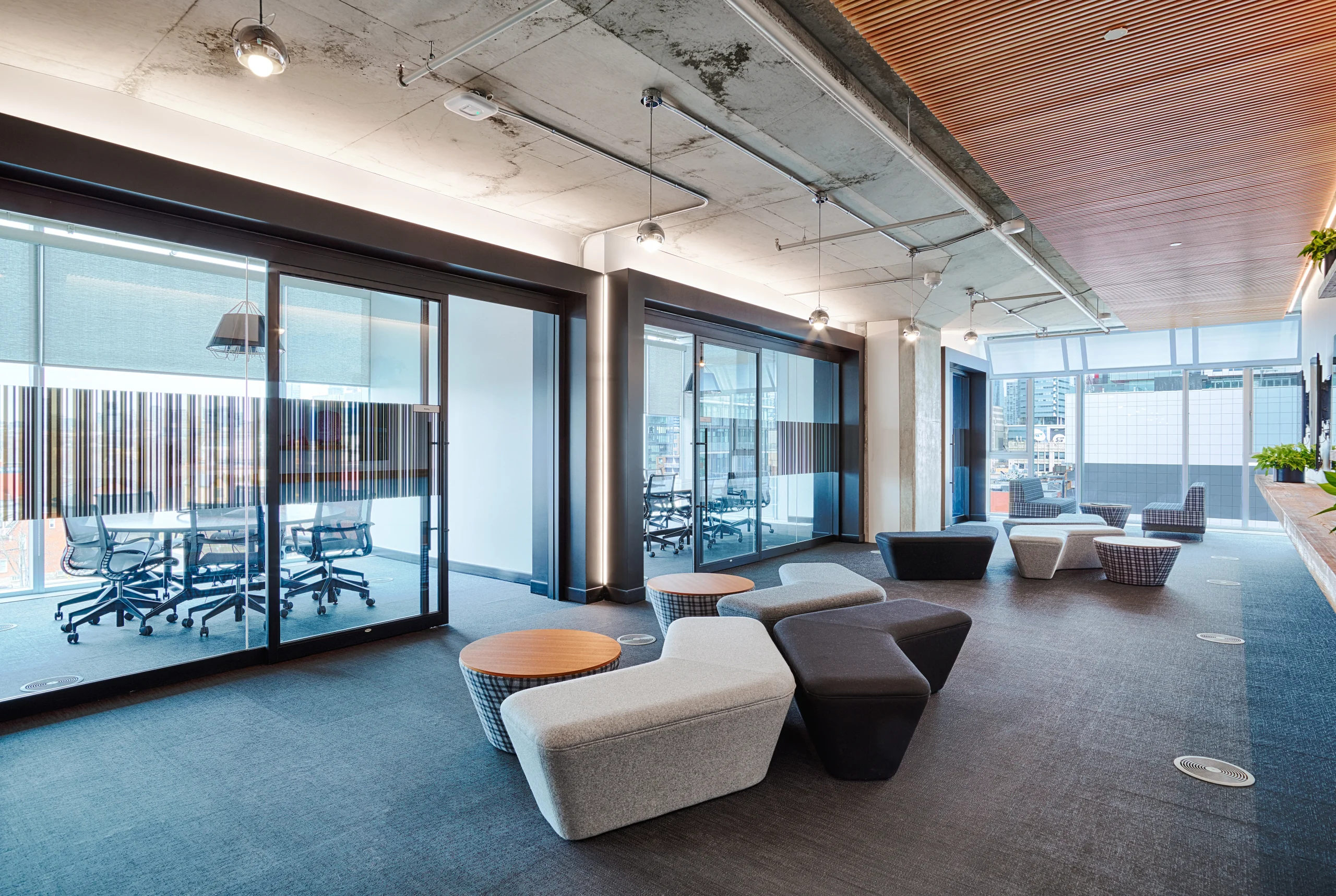
The environment plays an important role in making those moments possible. A comfortable lounge can become an informal meeting place, while a project room gives people the freedom to spread out, share ideas and work through a problem together. Good design doesn’t force these interactions. It simply creates the conditions for them to happen.
Good Workplace Design Often Feels Invisible.
We tend to notice a workplace when something isn’t working.
Maybe there’s nowhere private to take a call, meeting rooms are constantly booked or the office is too noisy to concentrate. Perhaps the technology creates more frustration than it solves. Small issues can add up quickly, shaping how people experience the space and how easily they can get through their day.
A well-designed workplace feels very different. The lighting is comfortable, the furniture supports the task at hand and it’s easy to find an appropriate place to work. Technology fades into the background rather than interrupting the experience.At its best, the workplace isn’t something people have to think about. It quietly supports the work they’re there to do.
Choice Only Matters When the Options Feel Different
A typical workday rarely stays in one mode for long.
Between focused work, meetings, virtual calls, collaboration and conversation, people move through a range of activities. The spaces supporting those activities should feel just as varied.
But choice only matters when the options are genuinely different. A row of open workstations beside a slightly quieter row of open workstations doesn’t offer much choice at all.
People need spaces with real differences in privacy, acoustics, posture and level of interaction. A quiet room should feel noticeably different from a social space. A project room should support a different kind of work than a meeting room. And a place intended for a private call should provide actual privacy.
This doesn’t necessarily require more square footage. Often, it’s about planning existing space more carefully and giving each area a clear purpose.
Space Should Work Harder, Not Just Be Fuller
For years, workplace planning focused heavily on capacity. How many desks fit? How many people can the floor accommodate? How efficiently can every square foot be used?
Those questions still matter, but they don’t tell the whole story.
A busy office isn’t necessarily a successful one. Occupancy tells us whether a space is being used, but it doesn’t tell us whether people can find privacy, collaborate comfortably, hear one another during meetings or move through the day without unnecessary friction.
A better measure is how well the workplace supports the activities people came in to do.
A lounge that hosts informal meetings, individual work and casual conversations throughout the day may be contributing far more than its size suggests. Meanwhile, a dedicated room that regularly sits empty might need to be reconsidered.
The value of a space isn’t simply how many people can fit into it. It’s how useful that space is throughout the day.
Designing for How Work Happens Now
The organizations thinking carefully about workplace design aren’t simply asking how to get people back into the office.
They’re asking what role the workplace should play.
The answer will look different for every organization. Some may need better spaces for collaboration and knowledge sharing. Others may need more acoustic privacy, stronger technology or quiet areas that support concentrated work. Many will need a balance of all these things.
Finding that balance begins with understanding the people using the space: how they work, when they need one another, what gets in their way and which activities benefit most from being together.
There isn’t one workplace model that works for everyone, and there probably shouldn’t be.
A worthwhile office isn’t simply attractive, flexible or full. It understands what people came in to do and makes those activities easier.
When the workplace does that well, the reason for making the commute becomes much clearer.